

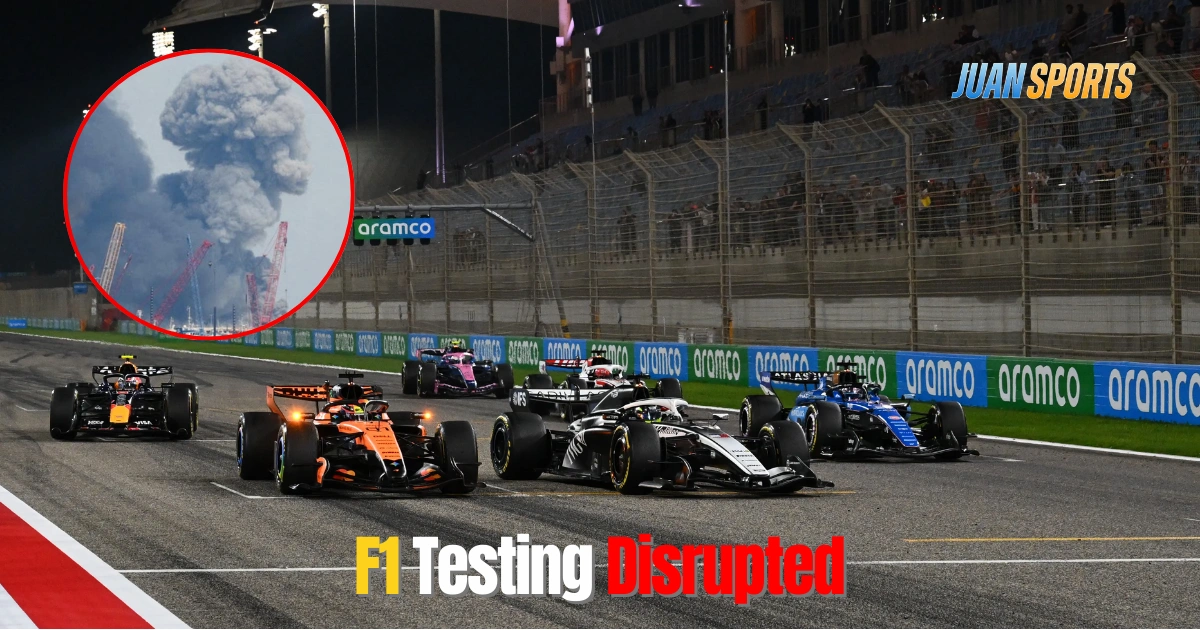
F1 testing at the Bahrain International Circuit on February 28, 2026, was abruptly disrupted due to escalating military tensions in the Middle East, delivering a sobering reality check for the start of the 2026 Formula 1 season. Tyre supplier Pirelli decided after a series of missile strikes, including a direct hit on a U.S. naval command center in Bahrain’s Juffair district, just 30 km from the Sakhir circuit.
The cancellation highlights the critical role of F1 testing in preparing teams for a season already defined by major technical changes, including narrower tyres, lighter chassis, and active aerodynamics. For engineers, every lap lost in F1 testing translates into fewer opportunities to optimize car performance before the opening races. Juan Sports reports that teams are now relying heavily on simulations to make up for lost track time.
The Cancelled Test: A Crucial Step Before Melbourne
The two-day session, scheduled for February 28 and March 1, was intended as the final chance to collect data on Pirelli’s 2026 wet-weather tyre compounds. Unlike standard pre-season testing, this session employed artificial sprinklers to simulate rainfall, allowing teams to analyze tyre grip, wear, and thermal behavior in controlled wet conditions.
Mercedes and McLaren had both brought “mule cars,” specially modified chassis designed to evaluate the new technical regulations. These cars were essential for testing suspension setups, energy recovery systems, and aerodynamic configurations. The sudden halt of F1 testing deprived teams of valuable information about tyre degradation patterns and car balance under wet conditions—an insight that could prove decisive in early-season races.
“The cancellation of F1 testing is a major setback,” said one senior engineer. “We rely on these sessions to calibrate the car, understand tyre behavior, and fine-tune setups. Losing this time means we will have to make adjustments on the fly during races.”
Personnel Safety and Emergency Evacuations
Following the missile strikes, Pirelli confirmed that all staff, including engineers and personnel from Mercedes and McLaren, were safe and accounted for in their hotels across Manama.
“The safety and security of our teams and staff is our top priority,” an F1 spokesperson stated, as emergency evacuation procedures were swiftly implemented to relocate roughly 2,000 personnel to safe locations.
The situation emphasizes that, while F1 testing is vital for performance, human safety must always take priority. Pirelli is coordinating with international authorities to arrange emergency flights back to Italy and the United Kingdom, ensuring that teams can continue preparations for the first rounds of the 2026 season.
With this disruption, teams are now relying more on simulations, historical data, and predictive modeling to make up for lost track time. Engineers will be under pressure to validate these simulations before the season opener.
Travel Chaos Ahead of the Australian GP
The cancellation of Bahrain testing has caused widespread logistical challenges, as teams race against the clock to reach Melbourne for the season-opening Australian Grand Prix on March 8, 2026.
Major aviation hubs in Doha and Dubai—the primary bases for Qatar Airways and Emirates—remain closed due to regional strikes, forcing teams to reroute flights via Hong Kong, Singapore, or direct Qantas flights to Perth to avoid volatile Middle Eastern airspace.
Impacted Hubs (as of March 1, 2026):
| Hub | Status |
| Doha (Qatar) | Closed due to regional strikes |
| Dubai (UAE) | Closed due to regional strikes |
| Manama (Bahrain) | Restricted; military activity nearby |
Without this session, teams face added pressure, emphasizing how crucial F1 testing is for adjusting aerodynamics, brake performance, and car balance. Missing live track evaluation adds uncertainty in tyre strategy, particularly given the 2026 regulations’ narrower tyres and modified compounds.
Monitoring the 2026 Calendar
While the immediate focus is on Melbourne, F1 chiefs are closely monitoring the broader 2026 calendar, particularly Middle East events. The Bahrain Grand Prix (April 12) and Saudi Arabian Grand Prix (April 20) remain under observation, with teams ready to adapt if the security situation escalates.
Upcoming 2026 F1 Schedule:
- March 8: Australian Grand Prix (Melbourne)
- March 15: Chinese Grand Prix (Shanghai)
- March 29: Japanese Grand Prix (Suzuka)
- April 12: Bahrain Grand Prix (Sakhir) — UNDER MONITORING
- April 20: Saudi Arabian Grand Prix (Jeddah) — UNDER MONITORING
The disruption demonstrates the importance of F1 testing, as teams now must rely heavily on simulations and predictive modeling to compensate for lost track time. Every lap missed in Bahrain increases uncertainty for engineers and drivers.
Technical Overhaul Meets Unexpected Crisis
The 2026 season represents one of the most significant regulatory changes in Formula 1 history, featuring lighter cars, active aerodynamics, and a 50/50 split between electric and combustion power. The cancellation of the Bahrain wet-weather session intensifies challenges for engineers, strategists, and drivers alike.
Without real-world data from F1 testing, teams must make adjustments using simulations alone, potentially affecting race strategies, car setups, and tyre management for the opening rounds. This situation shows that F1 testing is not merely a routine exercise—it is the backbone of competitive readiness in modern motorsport.
Tyre behavior, brake balance, energy recovery systems, and driver confidence all require calibration under live conditions, and the Bahrain session would have provided essential insights. Losing this opportunity forces teams to rely on theoretical models rather than validated performance data.
Strategic Implications for Teams
The absence of F1 testing data forces teams to rethink early-season strategies. Engineers must analyze simulations more deeply, while drivers must adapt to potential unknowns in grip and car balance. Teams with extensive historical data may have a slight advantage, but even seasoned teams cannot fully replace insights gained during live F1 testing.
Race-day strategies, pit-stop timing, tyre management, and energy deployment—all crucial under the new 2026 rules—will now depend on adaptive decision-making rather than prior track validation. Teams that can simulate real-world scenarios effectively will gain an early edge in both qualifying and race performance. This makes the remaining pre-season F1 testing sessions—even more critical for teams trying to catch up.
Historical Context: The Value of Pre-Season Testing
Historically, F1 testing has been a vital part of championship success. Teams that miss critical sessions often face early-season struggles. For instance, in 2021 and 2022, teams that optimized tyre behavior through extensive pre-season testing had a measurable advantage in race strategy and reliability. The Bahrain cancellation could similarly influence which teams emerge strongest in the first few rounds of 2026.
The Road Ahead
F1 management continues to coordinate with international authorities, security experts, and team representatives to ensure the 2026 championship begins safely. Teams are adjusting travel, testing, and logistics plans daily to accommodate potential disruptions.
For drivers, engineers, and fans, the Bahrain disruption highlights that the 2026 season will be defined not only by technological advancements but also by resilience. F1 testing is essential to identify car weaknesses, optimize performance, and build driver confidence. The cancellation serves as a reminder that safety must always come first, even if it means sacrificing crucial preparation time.
F1 testing remains the cornerstone of early-season preparation, shaping strategy, tyre management, and overall competitiveness. Teams will face the challenge of recovering lost insights while keeping pace in a season already defined by new regulations and unpredictable circumstances. Even in a crisis, the value of F1 testing cannot be overstated—it is the foundation upon which successful teams build their race-day strategies, adapt to technical changes, and push performance safely. According to Juan Sports, monitoring the remaining 2026 testing sessions will be critical for teams to gain a competitive edge.
Browse other News.

Leave a Reply