

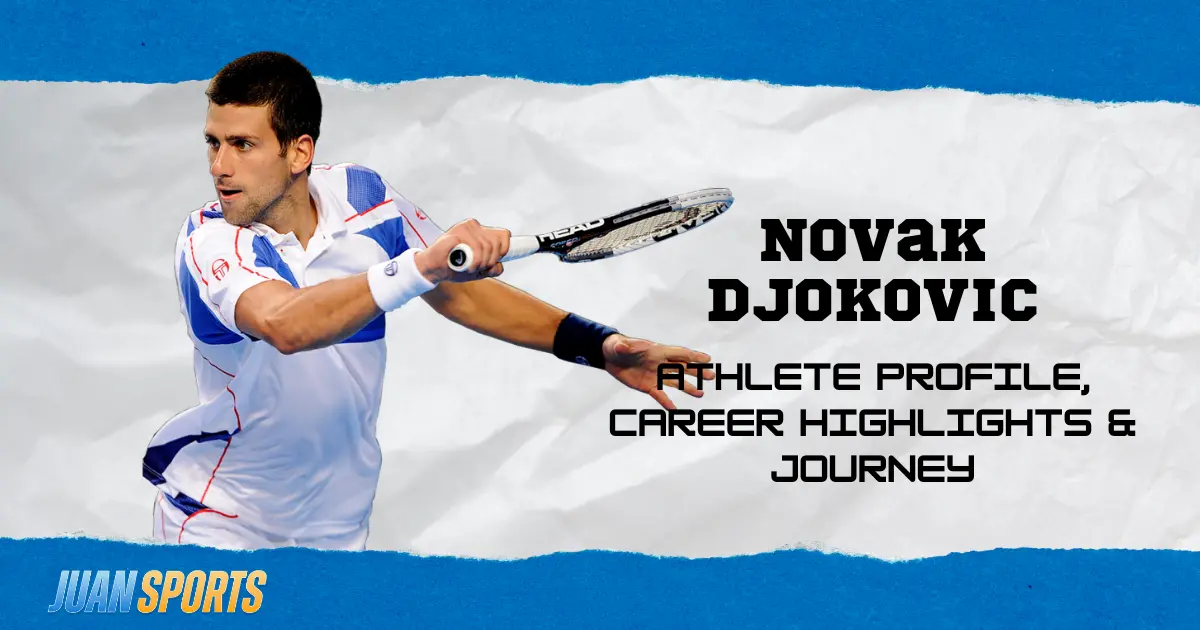
Novak Djokovic is widely regarded as one of the greatest athletes in the history of tennis—an icon defined not only by his record-breaking achievements but also by his mental toughness, resilience, and unwavering competitive spirit. From his early childhood in war-torn Serbia to becoming a 24-time Grand Slam champion, Djokovic’s journey is a story of relentless focus and an unshakable belief in his own potential.
What sets Djokovic apart is not just his physical skill but the mindset behind his success. His ability to adapt, fight through adversity, and mentally dominate the biggest stages has shaped him into one of tennis’ most complete and formidable champions. As we explore his story, Juan Sports celebrates the discipline, focus, and fight that define legends like Novak Djokovic—athletes whose greatness transcends the game itself.
Early Life in Serbia and Rise From a War-Torn Childhood
Novak Djokovic was born on May 22, 1987, in Belgrade, Serbia, during a period of political instability and economic hardship. His childhood took place in the middle of the Yugoslav Wars, where daily life was often uncertain. Despite the challenges, Novak Djokovic discovered tennis early—at age four—after his parents enrolled him in a small tennis camp across the street from their family-owned restaurant.
His talent did not go unnoticed. Jelena Genčić, a legendary Yugoslav tennis coach who had previously trained Monica Seles, saw Djokovic practicing and immediately recognized his potential. She later described him as “the greatest talent I have seen since Monica.” Genčić not only refined his technique but also exposed him to classical music, literature, and mental training—elements Djokovic still practices today.
During the NATO bombings in 1999, Djokovic often practiced with the sound of explosions in the distance. Many training sessions were held in improvised locations, including an empty swimming pool converted into a tennis court. Despite the chaos around him, his commitment never wavered. In interviews, Novak Djokovic recalled doing homework in bomb shelters and running to shelters between training breaks—an upbringing that shaped his mental resilience and perspective.
At 12, he left Serbia to train in Germany at the Nikola Pilić Academy—an enormous sacrifice for his family, who struggled financially to support his career. But the investment paid off. By his mid-teens, Djokovic developed into one of the most promising players in Europe, setting the foundation for his future rise to the top of world tennis.
First Breakthroughs and Transition to Professional Tennis
Novak Djokovic’s rise through junior tennis was steady rather than explosive, but his progression was marked by consistency and discipline. Unlike many future stars, he didn’t dominate the junior Grand Slams—instead, he focused on developing a complete game and gaining experience on tougher European circuits.
Djokovic turned professional in 2003, at age 16, and quickly made an impact in ATP Challenger and Futures events. His first significant breakthrough came in 2005, when he reached the third round of both the Australian Open and Wimbledon—his first real introduction to a global tennis audience.
A key turning point in his early career was addressing long-standing physical issues. Djokovic struggled with:
- respiratory problems,
- chronic fatigue, and
- difficulty maintaining stamina in long matches.
Many fans don’t know that before 2011, Novak Djokovic was close to quitting tennis because his body kept collapsing in high-pressure matches. For years, he blamed it on asthma. It wasn’t until 2010 that he discovered he had a gluten intolerance, which drastically affected his breathing and energy levels.
This discovery—suggested by a Serbian doctor during a simple food sensitivity test—completely changed the trajectory of his career. After switching to a gluten-free diet and overhauling his nutrition, Djokovic experienced:
- improved endurance,
- sharper focus,
- better recovery, and
- significant mental clarity.
Just a year later, the transformation became obvious.
In 2006, Novak Djokovic won his first ATP title in Amersfoort. A month later, he broke into the Top 20. By 2007, he reached his first Grand Slam final at the US Open and secured Masters titles, proving he was ready to challenge the Federer–Nadal stronghold.
These early milestones set the stage for Djokovic’s eventual dominance, marking the start of a career that would redefine tennis history.
The Gluten-Free Transformation: The Turning Point of His Career
One of the most important—and least understood—chapters of Novak Djokovic’s career is the dramatic health transformation that took place between 2010 and 2011. Before this shift, Djokovic was already a Top 5 player, but he was known for something unusual: he often collapsed, choked, or struggled physically in long matches, especially under heat or pressure. Many believed he lacked stamina compared to Federer and Nadal.
But the real problem wasn’t fitness—it was food.
For years, Djokovic battled:
- severe breathing difficulties,
- mid-match fatigue,
- dizziness, and
- the inability to maintain intensity in long rallies.
He visited countless doctors who diagnosed asthma, allergies, and even psychological stress. None of the treatments worked.
The Breakthrough Discovery
In 2010, Serbian doctor Igor Četojević watched Djokovic compete and immediately recognized symptoms linked to gluten intolerance. Through a simple muscle-resistance test, Četojević identified:
- gluten intolerance,
- dairy sensitivity, and
- issues with refined sugar intake.
This discovery shocked Novak Djokovic—he’d spent years thinking he simply “wasn’t built” for long matches.
The Diet Change That Changed Tennis
Djokovic removed gluten from his diet almost overnight. His transformation was immediate and dramatic:
- Better breathing
- Improved digestion
- Sharper mental focus
- Significant increase in endurance
- Fewer mid-match collapses
- More stable emotional control
He later documented this life-changing shift in his book “Serve to Win.”
Why This Moment Changed Tennis History
Just months after this diet overhaul, Novak Djokovic entered the 2011 season—one of the greatest ever recorded in men’s tennis.
People often remember his 2011 dominance, but many don’t know why it happened. His gluten-free transformation is the hidden catalyst behind his fitness evolution, mental clarity, and unstoppable rise to world No. 1.
This diet revolution didn’t just transform Djokovic—it influenced athletes globally. Today, countless professionals across sports credit Djokovic for making sports nutrition a mainstream topic among elite competitors.
Grand Slam Journey and Record-Breaking Achievements
Novak Djokovic’s career is defined by numbers that have reshaped tennis history. With 24 Grand Slam titles, he holds the record for the most major victories in men’s tennis—a milestone that cements his dominance across all surfaces and eras. But behind the statistics lies a journey of consistency, adaptability, and strategic evolution that set him apart from every generation of players.
Australian Open: The Court That Built a Legend
Novak Djokovic’s greatest success came in Melbourne, where he won a record 10 Australian Open titles.
What most people don’t know:
- He has never lost a final in Melbourne.
- His 2012 final vs. Nadal (5 hours, 53 minutes) is the longest Grand Slam final in history.
- The tournament’s heat and hard surface perfectly matched his flexibility, movement, and defensive mastery.
French Open: The Hardest One to Conquer
With Nadal dominating Roland-Garros for two decades, Novak Djokovic’s achievement here is especially rare. He won the French Open three times, becoming:
- One of the few men in history to defeat Nadal at Roland-Garros.
- One of the only players with multiple French Open titles during the Nadal era.
He also completed the Career Grand Slam here in 2016 and the Double Career Grand Slam in 2021—something Nadal and Federer never achieved.
Wimbledon: Mastering the Grass Era
Djokovic won 7 Wimbledon titles, and several of them came through legendary battles:
- The 2019 final vs. Federer (13–12 final-set tiebreak) is considered one of the greatest matches ever.
- He became the primary disrupter of Federer’s dominance on grass.
- Djokovic holds the record for the most Wimbledon titles in the Open Era after Federer.
US Open: Triumphs and Unexpected Setbacks
Djokovic has won 4 US Open titles, but his history here includes dramatic moments:
- He was defaulted in 2020 after accidentally hitting a lines judge with a ball.
- The US Open is the Slam where he lost the most finals—mainly due to dangerous heavy-hitters peaking against him.
- His 2021 run, attempting the Calendar Grand Slam, ended with Medvedev stopping him in the final.
Even with obstacles, his results in New York remain among the most consistent of any player.
The “Nole Slam” – Owning All Four Majors at Once
In 2015–2016, Djokovic became the first man since Rod Laver to hold all four Grand Slam titles simultaneously:
- Wimbledon 2015
- US Open 2015
- Australian Open 2016
- French Open 2016
He is the only player in modern tennis to do this across three different surfaces (grass, hard, clay).
Masters 1000 Dominance
Novak Djokovic is the only player in history to win the Career Golden Masters—all nine Masters 1000 events. Even more impressive:
- He completed this achievement twice.
No other player has done it even once.
Weeks at No. 1: Another Untouchable Record
Novak Djokovic holds the all-time record for:
- Most weeks at World No. 1 (more than 400 weeks)
- Most year-end No. 1 finishes in ATP history
This longevity reflects his ability to stay at the top through multiple eras of competition.
What Makes His Records Unique?
Many of Novak Djokovic’s records are considered “impossible” because they combine:
- success on all surfaces,
- multiple eras,
- Longevity,
- and a complete skill set.
His balance across clay, grass, and hard courts is unmatched, making his record-breaking achievements some of the most comprehensive in tennis history.
Legendary Rivalries: Federer, Nadal, and the Big Three Era
Novak Djokovic’s legacy cannot be separated from the rivalries that defined an entire era of tennis. His battles with Roger Federer and Rafael Nadal formed the foundation of the sport’s most competitive period—the Big Three Era, a period of nearly two decades where all three athletes pushed each other to historic heights.
These rivalries didn’t just produce unforgettable matches; they shaped Djokovic’s identity as a relentless competitor capable of breaking through two of the biggest icons the sport had ever seen.
Rivalry With Roger Federer – Breaking the “Untouchable” Era
Federer was already a global icon when Djokovic rose through the ranks. For many years, Federer fans saw Djokovic as an intruder disturbing the Federer–Nadal rivalry. What most people don’t realize is how deeply this dynamic sharpened Novak Djokovic’s mental toughness.
Key facts people often overlook:
- Novak Djokovic ended Federer’s 41-match winning streak in 2008.
- He beat Federer in three Wimbledon finals (2014, 2015, and 2019).
- The 2019 Wimbledon final, where Novak Djokovic saved two championship points on Federer’s serve, is widely considered one of the coldest demonstrations of mental strength in tennis history.
- Many Federer-Djokovic matches were played in stadiums where the crowd heavily favored Federer—something Djokovic often used as motivation.
Head-to-head: Novak Djokovic leads their rivalry, especially in Grand Slams.
Federer refined elegance and artistry; Djokovic represented efficiency and strategic pressure. Their contrasting styles produced some of the most dramatic matches in modern tennis.
Rivalry With Rafael Nadal – The Most Played Matchup in Tennis History
Djokovic vs. Nadal is the longest-running rivalry in the Open Era, with more matches played between them than any other pair in men’s tennis.
This rivalry is defined by extremes:
- Nadal’s unmatched intensity
- Djokovic’s flexibility and neutralizing defense
- Long, brutal baseline rallies
- Legendary physical endurance
Iconic facts:
- Their 2012 Australian Open final (5h 53m) is the longest Grand Slam final ever played.
- Djokovic is the only player to defeat Nadal twice at Roland-Garros, including one of Nadal’s worst losses there (straight sets in 2015).
- Novak Djokovic has a winning record against Nadal in hard courts and grass, while Nadal dominates on clay.
Their rivalry is considered the purest test of physical and mental limits in tennis.
The Big Three Era – Dominance the Sport Had Never Seen
Djokovic, Federer, and Nadal formed a triad of excellence that controlled tennis for nearly 20 years. Together, they:
- Won 66+ Grand Slams combined
- Held the No. 1 ranking for nearly two decades
- Prevented entire generations of players from winning major titles
- Elevated each other’s standards with every season
What most people don’t realize:
Djokovic is the only member of the Big Three with winning head-to-head records against the other two:
- Djokovic leads vs. Federer
- Djokovic leads vs. Nadal
This statistical advantage is one of the strongest arguments in the GOAT debate.
Why These Rivalries Matter
Each rivalry forced Novak Djokovic to evolve:
- Federer pushed him to refine his serve, shot selection, and aggression.
- Nadal pushed him to overcome his mental lapses, endurance limits, and emotional composure.
- Together, they shaped Djokovic into the most complete player of his era.
These battles created some of the most-watched and most intense matches in tennis history—and played a major role in forming Djokovic into the champion he became.
The 2011 Breakthrough Season: The Year Everything Changed
The year 2011 is widely recognized as one of the greatest single seasons in tennis history—and the moment Novak Djokovic transformed from a contender into a dominant force. Everything he achieved before this year was a preview; 2011 was the arrival of a new Novak Djokovic, both physically and mentally rebuilt.
A Near-Perfect Start
Djokovic began the 2011 season with an unbelievable 41-match winning streak, a run that included:
- Australian Open title,
- 4 Masters 1000 titles (Indian Wells, Miami, Madrid, Rome),
- and multiple wins over both Federer and Nadal.
Most fans don’t know that Djokovic actually extended his streak to 43–0 before losing to Federer at the French Open semifinal.
Dominating Nadal – The Unexpected Shift
Before 2011, Nadal was a major problem for Novak Djokovic, especially in finals. But in 2011, that changed dramatically.
Djokovic defeated Nadal six times in a row, all in finals:
- 2 clay finals
- 2 hard court finals
- 2 grass court matches (including Wimbledon)
This shift stunned the tennis world—no player had ever beaten Nadal like this across all major surfaces within a single season.
Major Titles of 2011
That year, Novak Djokovic won:
- Australian Open
- Wimbledon
- US Open
These victories pushed him to World No. 1 for the first time.
The Wimbledon Breakthrough
Novak Djokovic’s win over Nadal in the 2011 Wimbledon final was the symbolic moment of his career. Not only did he win the championship, but he also secured the No. 1 ranking the moment he reached the final.
This match marked the official beginning of Djokovic’s era.
Physical and Mental Transformation
Djokovic’s 2011 success wasn’t talent alone—it was the result of:
- solving his gluten intolerance,
- completely changing his diet,
- improved breathing and endurance,
- yoga and meditation practices,
- and a stronger, more stable emotional mindset.
Few people know that Djokovic began practicing mindfulness meditation daily around this time, something he credits for his focus during long rallies.
Why 2011 Matters in Tennis History
This season didn’t just elevate Novak Djokovic; it changed the balance of the sport:
- It forced Federer and Nadal to adapt.
- It introduced the era of the “Big Three” as an equal triad.
- It proved Novak Djokovic had no weaknesses across surfaces.
- It marked the longest sustained period of high-level tennis of his career.
Many analysts believe Djokovic’s 2011 season is the most complete season of any player in the Open Era.
Controversies, Setbacks, and Comebacks
Novak Djokovic’s career hasn’t been defined by success alone. Throughout his journey, he faced controversies, injuries, and periods of emotional struggle that nearly derailed his career. What makes his story unique is not the setbacks themselves but the way he consistently found a way back stronger than before.
Elbow Injury and the 2016–2017 Collapse
After winning the French Open in 2016 and completing the Career Grand Slam, Djokovic entered one of the toughest phases of his life.
He suffered a chronic right elbow injury that limited his serve and created insecurity in his game. Lesser-known details include:
- He played through pain for over a year.
- Multiple doctors advised him to stop playing temporarily.
- Novak Djokovic refused elbow surgery at first due to personal beliefs about healing naturally.
By 2017, his form dropped dramatically. He lost early in several majors, split with his longtime coach Marian Vajda, and questioned his motivation.
Painful but Necessary Surgery
In January 2018, after years of resisting, Djokovic finally underwent elbow surgery—a decision he called “the toughest of my life.” He later admitted he cried for days because he felt he “failed” by choosing surgery.
However, this moment became a turning point. Months later, he returned to top form and began another dominant stretch.
The 2020 US Open Disqualification
One of the most controversial moments in Novak Djokovic’s career occurred at the 2020 US Open, when he accidentally hit a line judge with a ball after losing a point. He was defaulted from the tournament immediately.
Most people don’t know:
- The act was unintentional; he wasn’t looking at the judge.
- He apologized privately and publicly within minutes.
- The incident led to temporary media backlash but no long-term penalty.
This setback motivated him, and he returned to win more Grand Slams afterward.
2022 Australian Open Deportation
Perhaps the biggest controversy of Djokovic’s career occurred in 2022, when he was deported from Australia before the start of the tournament due to a visa and vaccination dispute.
Important details:
- Djokovic arrived believing he had proper medical exemption paperwork.
- His visa was approved, then canceled after he arrived.
- He spent days in an immigration detention hotel before his appeal was rejected.
- The incident became a global news story beyond tennis.
Despite this, he returned in 2023 to win the Australian Open again—proving remarkable mental resilience.
Public Misunderstandings and Media Pressure
Djokovic has often been more scrutinized than his rivals due to:
- His outspoken personality
- Misinterpreted comments
- Cultural differences between Balkan communication and Western media style
Several times, he faced backlash for statements later clarified or mistranslated. Still, he learned to navigate the media spotlight with increased maturity.
Returning Stronger Every Time
What defines Novak Djokovic is his ability to rebuild:
- After injury → won majors
- After controversies → refocused mentally
- After media criticism → returned with strong performances
- After deportation → regained World No. 1
His pattern of falling, adjusting, and rising again has become a defining part of his legacy.
Playing Style and What Makes Him Nearly Untouchable
Novak Djokovic’s game is built on efficiency, precision, and resilience. While Federer mesmerizes with elegance and Nadal overwhelms with power and topspin, Novak Djokovic dominates by neutralizing everything—and giving nothing for free. His style is often misunderstood as “defensive,” but statistically and tactically, it is one of the most complete and difficult-to-break systems in tennis history.
Elite Return of Serve – His Greatest Weapon
Djokovic is widely regarded as the greatest returner in tennis history.
Key facts many people don’t know:
- He consistently ranks No. 1 or near the top in return games won, even against big servers.
- Novak Djokovic breaks opponents more often than most top 10 players hold serve.
- His anticipation is so strong that he sometimes reads serves before the toss is completed.
His return neutralizes big servers and turns tight matches into baseline battles he usually wins.
Movement and Flexibility That Defy Biology
Djokovic’s movement is unlike any other player:
- His sliding on hard courts (not just clay) is something no one did before him.
- His hip flexibility lets him retrieve balls from impossible positions.
- His balance during stretched defensive shots often resets rallies instantly.
Those slow-motion splits and slides are not just showmanship—they disrupt opponents’ rhythm and extend rallies into Djokovic’s comfort zone.
Perfect Defense-to-Offense Transition
Djokovic is the master of turning defense into attack within a single shot. His pattern:
- Retrieve a deep or aggressive ball.
- Redirect pace.
- Change direction immediately.
- Take control of the rally in one or two exchanges.
This frustrates aggressive players who expect winners but instead find the ball coming back faster and deeper.
Backhand: One of the Most Solid Strokes in Tennis History
His two-handed backhand is considered one of the most reliable shots ever. Why it’s special:
- He takes the ball on the rise effortlessly.
- He uses it to redirect cross-court changes to down-the-line shots instantly.
- He absorbs heavy topspin (like Nadal’s lefty forehand) better than anyone.
This single stroke changed the Nadal–Djokovic rivalry permanently.
Serve: Quietly One of the Most Effective
While not the fastest serve on tour, Djokovic’s serve is:
- one of the most accurate,
- perfectly placed under pressure,
- and statistically among the most efficient in big moments.
In 2023, he had one of the highest service hold percentages of his career—at age 36.
Mental Strength and Match Management
Perhaps Djokovic’s greatest separator is his psychology:
- He rarely panics.
- He makes almost no bad decisions in long rallies.
- He increases level at important points (break points, tiebreaks).
- He studies opponents’ weaknesses mid-match and exploits them instantly.
His record in tiebreaks and fifth sets ranks among the best in history, proving his ability to manage pressure.
Minimal Weaknesses
Unlike other greats:
- Federer had a weaker backhand early in his career.
- Nadal had limited variety on fast grass and indoor courts.
- Many top players struggled with certain surfaces.
Novak Djokovic is:
- Elite on all three surfaces,
- Strong in all baseline patterns,
- Unusually consistent physically and mentally,
- And adaptable to every style.
This completeness is why many experts consider him the most well-rounded tennis player ever.
Off-Court Life and Influence
While Novak Djokovic’s tennis accomplishments are historic, his influence extends far beyond the court. His off-court life is a blend of philanthropy, spirituality, wellness, and global advocacy—shaping him into one of the most multidimensional athletes of his generation.
Novak Djokovic Foundation – Education for Underprivileged Children
Founded in 2007, the Novak Djokovic Foundation focuses on early childhood education, especially in Serbia where quality preschools were limited after the war.
Important details many don’t know:
- The foundation has built or renovated 50+ preschools across Serbia.
- Over 57,000 children have benefited from its programs.
- Novak Djokovic personally visits schools and meets with teachers to understand community needs.
The foundation’s mission is rooted in Djokovic’s own childhood experiences and his belief that education can break cycles of poverty.
Spiritual and Mental Practices
Djokovic’s mental transformation is strongly connected to holistic practices, many of which fans don’t realize he uses consistently:
- Meditation (daily, often twice a day)
- Breathing exercises and mindfulness
- Yoga and stretching routines
- Visualization techniques before and during matches
These habits are a big part of his longevity and emotional control.
Lesser-known fact: Djokovic once said meditation helped him handle the pressure of playing Federer and Nadal in hostile crowds.
Nutrition and Wellness Influence
After the discovery of his gluten intolerance, Djokovic became a global advocate for:
- plant-based diets,
- clean eating,
- hydration awareness,
- and mindful food choices.
He has invested in wellness restaurants and launched a healthy food line in Serbia.
Business Ventures
Novak Djokovic has expanded his influence into various industries:
- Eqvita, a vegan restaurant (later closed)
- Investments in biotech and wellness startups
- A tennis center in Serbia
- Ownership stakes in tech companies focusing on athlete data, AI, and recovery tools
He prefers purposeful investments rather than luxury endorsements.
Family and Personal Life
Djokovic married his longtime partner Jelena Ristić in 2014, and they have two children. Jelena also serves as the director of the Djokovic Foundation, making their philanthropic work a family effort.
Djokovic often speaks about:
- grounding himself through fatherhood,
- balancing tennis with family life,
- and wanting his children to remember him as a good person—not just a champion.
Influence on Global Tennis
Djokovic has directly helped grow tennis in Serbia and the Balkans:
- He funded training programs for young athletes.
- Inspired the rise of players like Krajinović, Lajović, and Kecmanović.
- Elevated tennis culture in a region where basketball and football historically dominated.
He has also been a key voice in player rights, co-founding the Professional Tennis Players Association (PTPA) to give players more influence in tour decisions.
Djokovic’s off-court life reveals a deeply intentional person—an athlete committed not only to winning but also to education, health, equality, and the long-term growth of tennis.
Novak Djokovic’s Place in Tennis History
Novak Djokovic’s journey from a war-torn childhood in Serbia to becoming one of the greatest tennis players in history is a story built on persistence, adaptability, and an extraordinary ability to evolve. His breakthroughs didn’t come from privilege or early dominance—they came from constant adjustments, strategic discipline, and an unwavering belief in self-improvement.
Djokovic changed his game through nutrition, mindset work, physical transformation, and technical refinement, proving that greatness can be engineered through intentional choices. His rivalries with Federer and Nadal defined an era, but his resilience through controversy, injuries, and global scrutiny is what truly sets him apart. Whether admired or criticized, his impact on tennis is undeniable: he reshaped the sport’s physical standards, mental expectations, and longevity.
See also other Athletes Profile here.
Citations
Novak Djokovic Official Website
Olympics
ATP Tour
Forbes
Novak Djokovic Foundation
Britannica
